
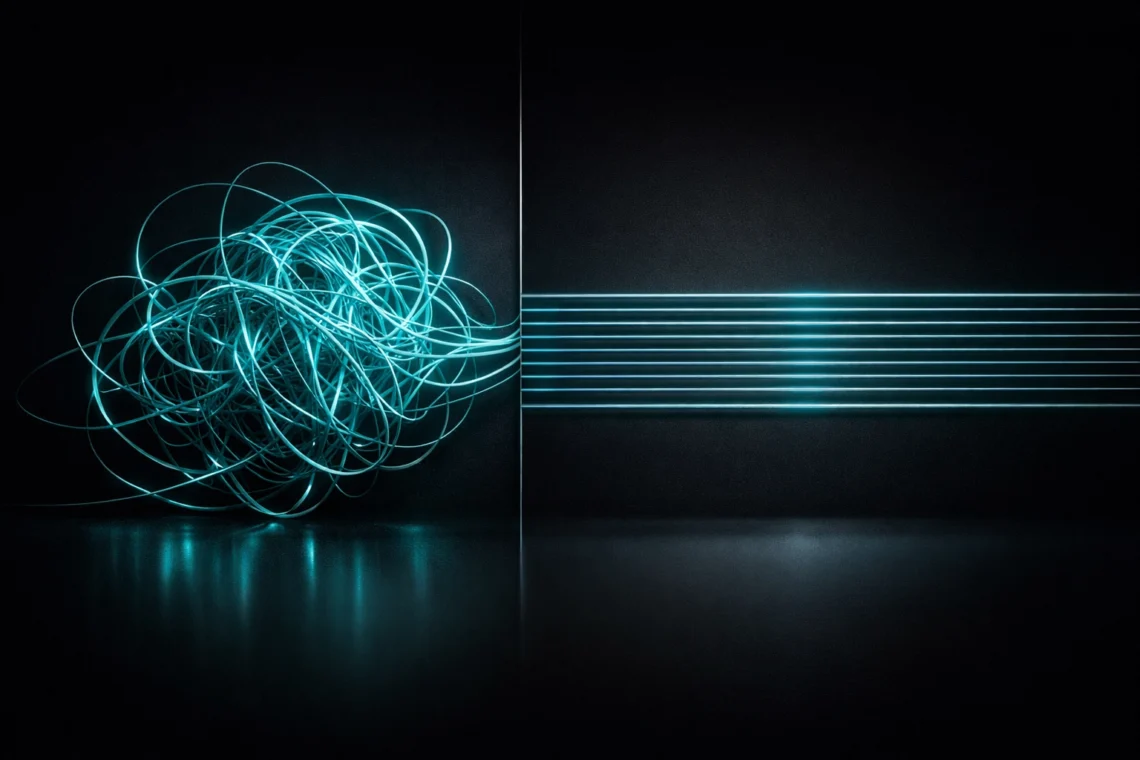
It’s 2:00 AM. You’re staring at the ceiling, and your mind is running a marathon you didn’t sign up for. You’re replaying a conversation from three days ago, dissecting a decision you made last month, or simulating a "what if" scenario for a meeting that hasn’t even happened yet.
Sound familiar?
You’ve likely been told to "just stop thinking about it." You’ve tried "positive thinking." You’ve probably even tried to distract yourself with endless scrolling or extra work. But the thoughts keep coming back, looping like a broken record that won’t skip to the next track.
This is rumination. And for most people, it isn’t just an annoying habit, it is a massive drain on your mental battery that quietly sabotages your performance, your clarity, and your quality of life. At Primary Self, we look at this through the lens of performance coaching. If your mind is the operating system for your life, rumination is the background process that’s hogging all the CPU power, causing the rest of the system to lag and eventually crash.
In this guide, we are going to break down why you ruminate, the hidden "decision fog" it creates, and how you can actually rewrite these subconscious patterns using PSYCH-K® to effectively interrupt the ruminative spiral.
The Background Process: Why Rumination Drains Your Mental Battery
Think about your smartphone. When you have fifty apps open, even if you aren’t actively using them, the battery drains faster. Your brain functions in a remarkably similar way.
Most people view rumination as "problem-solving." They think that if they just chew on the thought long enough, they’ll find a solution or a sense of peace. But there is a fundamental difference between productive reflection and chronic rumination. Reflection leads to an insight or an action plan. Rumination leads to a loop.
When you ruminate, you are engaging in background processing. You are dedicating significant cognitive resources to a loop that has no "exit" command. This constant activity keeps your nervous system in a state of low-grade "fight or flight." Your body doesn't know the difference between a real-world threat and a perceived social threat you're obsessing over; it just knows your heart rate is up and your focus is fractured.
This is why you feel exhausted at the end of the day even if you haven't done much physical work. Your mental energy has been siphoned off by the "Internal Narrator" who refuses to shut up.
The Decision Fog: The Invisible Tax on Performance
One of the most damaging side effects of rumination is what we call Decision Fog.
High-level performance requires decision clarity. You need to be able to assess variables, trust your intuition, and execute. However, when you are caught in a ruminative cycle, your prefrontal cortex, the part of the brain responsible for executive function, is effectively hijacked.
Every time you overthink, you create a layer of "noise" that obscures the "signal." This results in:
- Analysis Paralysis: You become so afraid of making the "wrong" move that you make no move at all.
- Micro-Decision Fatigue: You waste your best mental energy on trivialities, leaving nothing left for high-stakes choices.
- Lack of Presence: You aren't actually in the room during meetings or family dinners; you're stuck inside your own head.
For the general population, this manifests as a feeling of being "stuck." You know what you need to do, but you can't seem to find the clear path to do it. The fog is too thick. You aren't lacking talent or intelligence; you're lacking the mental bandwidth to apply them.

Why Conventional "Overthinking Help" Often Fails
If you’ve searched for overthinking help before, you’ve likely encountered the same three pieces of advice:
- "Just think positive."
- "Distract yourself."
- "Write it down."
While these can be helpful Band-Aids, they rarely solve the root cause. Why? Because rumination isn’t a conscious choice. You don't choose to stay awake at 2:00 AM obsessing over a mistake. It is an automated response triggered by your subconscious mind.
Your subconscious is designed to keep you safe. Somewhere along the line, your internal "operating system" decided that obsessively reviewing "threats" (like social rejection, failure, or uncertainty) was a survival strategy. Simply "trying" to think differently is like trying to change the code of a software program by shouting at the monitor. It doesn't work because you aren't accessing the source code.
This is where the distinction between "coaching" and "therapy" becomes vital. At Primary Self, we aren't interested in just talking about the loop for months on end. We are interested in the Decision Architecture of your mind. We want to identify the glitch and recalibrate the system.
The Subconscious Gap: The 95% Problem
Research suggests that about 95% of our thoughts, feelings, and behaviors are driven by the subconscious mind. Only 5% is conscious.
When you try to stop ruminating using willpower alone, you are using that 5% to fight against the 95%. It’s a losing battle. The subconscious is millions of times faster at processing information than the conscious mind. If your subconscious believes that "worrying keeps me safe," no amount of "positive affirmations" will override that deeply held belief.
To move past chronic overthinking, you have to bridge the gap. You have to move past the conscious chatter and address the underlying belief patterns that are fueling the fire.
Introducing PSYCH-K®: Rewriting the Root Cause
So, how do we actually access that subconscious "source code"? This is where PSYCH-K® comes in.
PSYCH-K® is a "high-speed" process designed to change subconscious beliefs that limit you. It’s not about "talking through" your problems; it’s about using a set of simple, non-invasive processes to achieve a "Whole-Brain State."
The Whole-Brain State
When we ruminate, we are often stuck in a "split-brain" state. One hemisphere might be trying to be logical, while the other is overwhelmed by emotion. Or, we might be over-identifying with the "logical" left brain, trying to calculate our way out of a feeling.
The Whole-Brain State is a bilateral, symmetrical brain-wave pattern. In this state, the communication between the left and right hemispheres is optimized. This is the "sweet spot" where the subconscious becomes highly receptive to new information.
By using PSYCH-K® "Balances," we can take a ruminative thought, for example, "I am constantly worried about what others think of me", and replace the underlying belief with a supportive one, like "I am secure and confident in my own choices."
Why It Works for Rumination
Unlike traditional talk methods that can actually reinforce the ruminative loop by making you talk about it over and over, PSYCH-K® focuses on the goal state. We identify the stressor (the thought loop) and then use the Whole-Brain State to "reprogram" your response to that stressor.
Suddenly, that thought that used to trigger a three-hour spiral doesn't have the same "hook" anymore. The mental energy that was being used to fuel the fire is reclaimed. You aren't "trying" to be calm; your system is simply no longer producing the stress response.
Reclaiming Your Mental Energy: The ROI of Clarity
When you effectively interrupt the ruminative spiral, your mental energy doesn't just return, it compounds.
Imagine what you could do with an extra two hours of peak cognitive focus every day. Imagine being able to make a decision and then moving on without a second thought. This is the "ROI" of mental clarity.
At Primary Self, we treat your mental capacity as your most valuable asset. If you were a professional athlete with a nagging injury that slowed you down, you’d seek specialized physical coaching to fix the mechanics. Rumination is a performance drain. It slows down your processing speed, reduces your stamina, and prevents you from playing at your highest level.
How to Start Breaking the Pattern Today

While deep-seated subconscious patterns are best addressed through professional coaching packages, there are immediate steps you can take to start weakening the ruminative loop.
1. Label the Loop
The moment you catch yourself overthinking, say it out loud: "I am ruminating."
By labeling the process, you create a tiny bit of "cognitive distance." You move from being the thought to observing the thought. This shifts the activity from the emotional centers of the brain back toward the prefrontal cortex.
2. The "Actionable vs. Ghost" Filter
Ask yourself: "Is there a specific action I can take in the next 10 minutes to resolve this?"
- If Yes: Do it immediately.
- If No: It’s a "Ghost Thought." It has no substance. Acknowledge that your brain is currently "background processing" and move your physical body. Change your environment.
3. Somatic Interruption
Rumination is a head-heavy state. To break it, you need to get back into your body. Rapidly changing your physical state: splash cold water on your face, do ten pushups, or practice deep, box breathing: can temporarily disrupt the neural feedback loop.
4. Upgrade Your "Mental Software"
If you find that the same themes keep coming back: fear of failure, need for approval, perfectionism: realize that these are not "truths" about who you are. They are simply outdated software programs.
This is where PSYCH-K® packages become the ultimate tool. Instead of fighting the symptoms (the overthinking), we go straight to the cause (the belief) and rewrite it.
The Architecture of a Clear Mind
Building a life free from rumination isn't about achieving a state of "nothingness" like a monk on a mountain. It’s about Decision Architecture. It’s about building a mental framework where your thoughts serve your goals, rather than your goals being held hostage by your thoughts.
When you work with a coach to address these subconscious blocks, you are doing more than just "getting over" a problem. You are optimizing your personal operating system. You are ensuring that your decision clarity is sharp, your energy is protected, and your focus is directed toward the things that actually matter.
High-performers aren't people who never have a negative thought. They are people who have the tools to ensure those thoughts don't turn into a permanent spiral. They have the "system" to process, clear, and execute.
Conclusion: Interrupt the Loop, Start Rebuilding
The "spiral" feels permanent when you're in the middle of it. It feels like "just who I am." But it isn't. It’s a habit of the mind fueled by subconscious beliefs that were likely formed years ago.
You don't have to live in the "Decision Fog." You don't have to end every day feeling mentally bankrupt. By understanding the mechanics of rumination and utilizing tools like PSYCH-K® to address the subconscious root, you can reclaim your mental energy and move forward with a level of clarity you didn't think was possible.
If you’re ready to interrupt the background processing and start performing at your peak, it’s time to look at what’s happening under the hood. Your "Primary Self" is the version of you that isn't bogged down by the noise. It’s time to get back to that version of you.
Ready to clear the fog? Explore how we can help you rewrite your internal narrative through our coaching services.
The loop changes when you decide to change the code.
Legal Disclaimer: Primary Self provides performance coaching and strategic mapping. We are not a medical practice, clinical psychology service, or therapy provider. This content is for informational purposes only and does not constitute medical advice or treatment for clinical conditions such as anxiety disorders or OCD. If you are experiencing a mental health crisis, please consult a licensed medical professional or mental health practitioner.